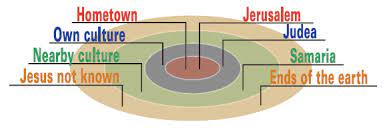
If you have been around the Protestant church in America as long as I have, you may be familiar with a certain use of Acts 1:8. In fact, you may have heard it so often, that it seems normal to you and you don’t see anything wrong with it. Sadly, however, our interpretations and application of this passage are often misguided. Let me share the passage with you first, and explain my thinking.
“But you will receive power when the Holy Spirit comes on you; and you will be my witnesses in Jerusalem, and in all Judea and Samaria, and to the ends of the earth.”
Many of our church leaders today present this passage as teaching that each believer has a personal “Jerusalem,” (people closest and most like them) which they are called to reach first and foremost. Then there are people near them both physically and culturally (Judea). Others are near them physically, but different culturally (Samaria). Finally, there are all the faraway and different people (the ends of the earth). I’ve heard this idea in a variety of settings. A number of applications flow from this idea, some better than others, but they all stem from a misunderstanding.
Sincere believers often unknowingly promote this widespread exegetical fallacy, which is easily dismantled when you realize that the apostles were not from Jerusalem. In fact, three verses later, the angel addresses them as “Men of Galilee.” In Acts 2, the people were also amazed at the various languages spoken by the apostles and said, “Are not all these men who are speaking Galileans?” (2:7). In fact, the people of Jerusalem were able to recognize folks from Galilee just from their manner of speaking. At the end of Matthew, during the trial of Jesus, we find this: “After a little while, those standing there went up to Peter and said, ‘Surely you are one of them, for your accent gives you away.’” (Matt. 27:72). People of Galilee were different, they did not fit in, and they were probably looked down upon. Jerusalem was not “home” to the apostles. It was a place where they did not fit in, where they were normally a bit uncomfortable, and especially now, at the beginning of Acts, it was the place where Jesus had been crucified, making it the most dangerous place for them.
So, why would Jesus want them in Jerusalem? In Acts 1:4, he told them not to leave, but to wait for the promised Holy Spirit. He did this because it was the strategic, God-ordained location for them to begin the Christian movement that would spread to the ends of the earth. In Luke 24:47, in a parallel passage also before his resurrection, Jesus said, “Repentance and forgiveness of sins will be preached in his name to all nations, beginning at Jerusalem.” The apostles were to begin in Jerusalem, the place where devout Jews would repeatedly come from many other places (Acts 2:5), and then return to their homes. Others like the Ethiopian eunuch would also come to the temple seeking God (Acts 8). It was an ideal place to reach the world with the new message of Christ.
It’s also important to realize that this verse provides a framework for the entire book of Acts. In the first seven chapters, the church was spreading in Jerusalem. Starting from chapter 8, pressed by persecution, they took the message to all Judea and Samaria. Peter’s interaction with Cornelius in chapter 10, and then the ministry of Paul took the message to the farthest parts of the known world to the west. Others like Thomas and the Ethiopian eunuch took the message in other directions.
Additionally, it’s worth pointing out that this statement of Jesus was a response to a question. Verses 6 and 7 read, “Then they gathered around him and asked him, ‘Lord, are you at this time going to restore the kingdom to Israel?’ He said to them: ‘It is not for you to know the times or dates the Father has set by his own authority. But you will receive power…” Jesus somehow needed to clarify to his followers that his resurrection was not about Making Israel Great Again, but about bringing the Kingdom of the Living God to all peoples throughout the world. And power would be demonstrated not by national greatness but by boldness in love, proclamation, and willingness to suffer.
So, what does this mean for us today? There are well-meaning but misguided applications that come from this passage. One is the assumption that our primary witness as Christians should be with those currently closest to us and most like us. Are some people called to that? Absolutely. But today, you and I live in “the ends of the earth” and are still charged with spreading the message to those who have not heard. Yes, we should absolutely be concerned about our family members and should make sure they hear the gospel and have opportunity to respond to it. But when they have had opportunity, we should be ready to move on and go to those who don’t have anyone near them who can share with them. What makes us convinced that a cousin, for example, who has heard the gospel seventy-one times, will somehow be convinced by number 72? Perhaps he will, and we should be ready. But that burden should not stop us from going to those who have never heard. As Keith Green once said, “Nowhere is the gospel more plentiful than in the United States.” I can’t say if that is true anymore, or if we have been surpassed by some other places like Uganda or Costa Rica, but it remains true that Americans have many opportunities to hear the gospel, while people in some other places have very few.
Another misguided application is that this framework is meant to be sequential today. Although it was for the apostles, we should not assume it is for us now. Many Christians are convinced that they should wait to be involved in witness to the ends of the earth until they have effectively reached those close to them. But how many people need to believe before a group can be considered to be effectively reached? Again, bear witness to them, let them hear, but don’t wait for something that may never happen. We have no promises from Scripture that all of our family members will believe, but we do have promises that people from all nations will (Rev. 5:9, 7:9, for example). We have no reason to believe that any group of people will ever have a large majority of true believers, so let’s stop striving for that.
The third misguided application is seen in some committees which allocate mission funding in churches. I have heard of churches which divide their funding destinations in three or four equal portions, solely on the basis of this verse. What they usually don’t consider is that, first, nearly all of their people are already present in their own community and can carry out a tremendous amount of witness with little to no funding, but rather spending from their time and energy. Second, these churches tend to overlook that the vast majority of their budget is already spent locally. Their building, their pastor’s salary, their youth ministry and childrens ministry, etc. all should have an outreach component, but do we spend an equivalent amount on the unreached in faraway places? Third, churches often dedicate a portion of their local “mission” budget on local ministries that are primarily for the benefit of church people. Christian schools, Christian colleges, ministries at secular universities, Christian camps and parachurch youth ministries all can and should have an outreach component, but if we are honest, they mostly serve to keep our own kids in the faith. Should they be supported? Absolutely. Just don’t call it mission support. To be clear, when there are local outreach ministries that are primarily designed for unchurched people (food pantries, pregnancy centers, homeless shelters, etc.), then by all means fund those as missions. But my concern is that church mission committees are hunting for more local ministries to fund because their people care about them and they feel they should be doing more locally, or somehow balance out their international efforts with local ones.
Those sincere Bible expositors who are teaching these interpretations are rightly calling us to pay attention to those around us as we also pay attention to the whole world. They are not wrong to do so. There are some churches that assume the people around them are fine, and direct all their energies to supporting international work, and may be happy when they can pay someone else to do it. Yes, they need to wake up to the needs around them. But is the best way of doing that by neglecting global needs? You can simultaneously care about the intense physical suffering and almost utter spiritual blindness in some parts of the world, and also care about those around you who are so wrapped up in the things of this world that they ignore and show contempt toward God. I actually think a greater danger is that most Christians are so wrapped up in their own lives that they are ignorant of both the needs around them and far away. And most churches are so obsessed with improving their facilities and flashy presentations, justifying these expenses as “efforts to reach our neighbors,” when really they mostly benefit us, that faraway people we have never met are neglected.
So, what does this verse mean? First, it is that the kingdom of God is not about restoring greatness to one ethnic group (ethnic Israel), but rather it is about renewing all of Creation beginning in the home base of that group (Jerusalem). The power of the Holy Spirit will make the followers of Jesus into bold witnesses to people near and far. Those who follow Him today are charged with the joyful duty to identify parts of the “ends of the earth” which are still lacking in a credible gospel witness, and to work together to provide a witness in those places and among those people.
For more on the neglect of the unreached peoples of the world, check out this webpage and/or the following video.

 HIS WORDS, HIS WORKS, HIS WAYS