Several years ago I heard about an informal survey illustrating ways in which Christians of different national backgrounds understand the well-known story of the Prodigal Son from Luke 15. I had shared these insights with a number of people, but until recently had not taken the time to look up the source and the whole story. Now that I have, I found it fascinating.
Mark Powell is a retired New Testament professor from Trinity Lutheran Seminary in Columbus, Ohio. In his 2007 book What Do They Hear? he discusses observations he has made over his career of teaching. In Chapter Two, he discusses the impact of social location and uses understandings of the Prodigal Son story to illustrate. In his seminary classes, he would pair up students, have them read a story, close the books, then retell the story to each other. They would then look and take note of the details they remembered and those they neglected. He noticed a remarkable degree of factual errors, both additions and omissions, as one might expect. As he embarked on this exercise with the Prodigal Son parable, he made some striking observations.
Powell noticed that in a group of twelve students, every student left out the mention of the famine in verse 14. Since the tendency to neglect this detail was so frequent, he looked into the matter a bit more. He surveyed one hundred students, and found that only six mentioned the famine in their retelling. Among all these American students, there was no one group that seemed to defy the trend. He then had an opportunity to interact with students in St. Petersburg, Russia, in 2001. In this survey, forty-two out of fifty respondents mentioned the famine. In learning more about that city’s history, he learned that the German siege in World War II resulted in a 900-day famine, in which 670,000 people died. This horrible ordeal was still alive in the memory of the people–even newcomers to the city, and made an impact on their thinking in many ways.
At the same time, Powell found that all of his American students mentioned that the prodigal son squandered his wealth. As for the Russians, only seventeen out of fifty mentioned this detail. They told him that squandering his wealth would only make the son poor, like everyone else. But it was the famine that made him hungry and caused the crisis for him.
| Americans | 100% mention squandering | 6% mention famine |
| Russians | 34% mention squandering | 84% mention famine |
What does this mean for the two groups? Powell suggests that for the Americans, the young man’s greatest sin was wasting money. It shows our values. Money is important to us and it should be used carefully. For the Russians, his sin was trying to be self-sufficient; he was acting like a fool.
Later, Powell continued his research while visiting East Africa. It seems that his time was limited, so he only asked them one question–”Why does the young man end up starving in the pigpen?” Expecting them to answer that he had wasted his money or that there was a famine, he was surprised. 80 percent of the Tanzanians wrote something along the line of “Because no one gave him anything to eat.” For them, the people of the foreign country should have treated him with kindness and shared with him. The fact that they didn’t it shows they were dishonorable, in contrast to the father’s house where he treated everyone well.
Which group is right? There is a sense in which all are. The young man did squander his wealth, there was a famine in the land, and indeed nobody gave him anything to eat. They are all in the text:
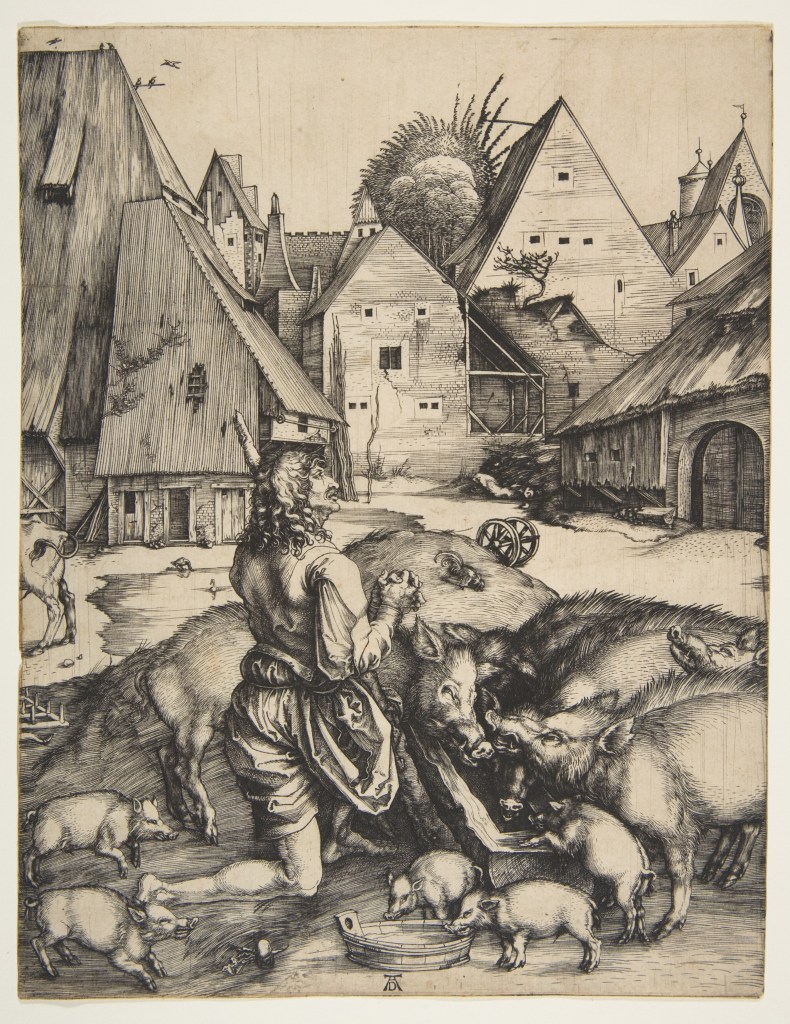
13 “Not long after that, the younger son got together all he had, set off for a distant country and there squandered his wealth in wild living. 14 After he had spent everything, there was a severe famine in that whole country, and he began to be in need. 15 So he went and hired himself out to a citizen of that country, who sent him to his fields to feed pigs. 16 He longed to fill his stomach with the pods that the pigs were eating, but no one gave him anything.
The Americans focus on the personal responsibility and the value of money. The Russians rightly point out that disasters happen and cause difficulties for us. And the Tanzanians emphasize the communal responsibility to care for others, even strangers.
A few years ago, I asked a group of Jordanian Christians this same question–why was he hungry?. I received a variety of answers, but the novel one that stood out to me was that “he left the father’s house.” This is also true. The father’s house is the place where you are known and others will care for you.
I think this is a great illustration of how our “cultural lenses” can cause us to emphasize some parts of Scripture, and give us blind spots to other important teaching. We gain quite a lot when we read the Bible with others who come at it from a different “social location.” Would you agree?

 HIS WORDS, HIS WORKS, HIS WAYS