In this post, I read and discuss James 3.
Author: marklachonce
Mark lived with his family in the Middle East for fourteen years before returning to the US in 2018 to pursue a PhD in World Christianity. Mark is continually learning more about following Jesus, caring for the marginalized and hurting, and pursuing the humble way of the cross that Jesus showed us. Mark appreciates your comments and prayers!
Video Series – Reading the New Testament in an election season, Session 2
In this post, I read and discuss James 2.
Video Series – Reading the New Testament in an election season, Session 1
After several discussions with friends regarding the intersection between faith and politics, I decided to record a few videos in which I read a portion of the New Testament and discuss how it speaks to me in relation to our current political discussions. I fully realize these passages won’t speak to others in the same way, but I do hope it may be beneficial to some. I’ve decided to begin with the Epistle of James because it is so immensely practical and I’ve found a number of places in which it has honed my thinking. We’ll see where this series takes us!
Hashtag blessed

The word “blessed” has become a commonly-used cliché in Christian circles. I recently heard someone suggest, while giving advice on how to be a Christian witness in the workplace, that we signal our Christian faith by saying “I am blessed” rather than “I am lucky/fortunate” when something good happens in our lives. For further insight, check out #blessed on Twitter. Or maybe not. It’s a pretty shocking display of the phenomenon I’m about to describe, which is not at all in line with how “blessed” is used in the New Testament.
Contemporary believers love to invoke the word “blessed” in reference to their achievements – buying a new, lavish car or home, sitting down to an extravagant meal, receiving recognition for talent, etc. After following #blessed on Twitter for a little while, I can conclude that it’s particularly well-used among high school and college athletes sharing their accomplishments. Well, we love to share the great things in our lives, and I admit that I do myself sometimes. But the question came to me: “When we find the word ‘blessed’ in the Bible, what does it mean? Is it used the same way we are using it?”

First of all, I do believe that the Old Testament looks at “blessing/blessed” in a broad sense. Material blessing (livestock and other property) is bestowed upon people like Abraham, Isaac and Jacob. David and Solomon are blessed with a strong kingdom. Others are even blessed with victory over their enemies. Still others receive a “blessing” from their fathers (remember the blessing that Jacob stole from Esau?) Wealth, land, political sovereignty, physical protection, all are considered “blessing” along with spiritual blessings given by God. I would contend that this understanding is pretty much in line with how many Christians use the term today.
But what about the New Testament? As Christians, when we discover that a concept is used radical differently in the New Testament than the Old, we need to consider that and take seriously the New Testament understanding. Jesus is the Word of God in a more fundamental way than the words of Scripture, and we use His teaching as a lens to understand the whole Bible. I have undertaken to study how “bless/blessed/blessing” is used in the New Testament, and share some observations.
First, there are two sets of Greek words that are used for bless/blessed/blessing. The first is makarios and the words related to it. This is used about fifty times in the New Testament. This word generally carries the sense of “fortunate, prosperous, happy.”
The other family of words is eulogeo (the verb) and eulogia (the noun, meaning “blessing”) and other related forms of the same word. These are used about sixty-five times, many times in reference to God. The basic meaning of this word is “to speak well of.” People can be spoken well of, or receive a well-spoken word. One form, eulogetos, seems to be reserved for God, as in Mark 14:61 when the high priest asks Jesus, “Are you the Christ, the son of the Blessed?” Forms of this word are also used in the Septuagint (Greek translation of the Old Testament, produced before the time of Christ) in Genesis 12:2-3 (when Abram is “blessed to bless all the peoples of the earth”) and in reference to the “blessing” that Jacob stole from Esau in Genesis 27.
Although there are these subtleties, I don’t think it makes a great difference which of these words is used in each case. More importantly, we should consider how they are used and in what ways people are called “blessed.” I’ve done a careful study, and made the following observations.
1. When Jesus arrived on the scene, one of his first teachings was a set of statements we call the Beatitudes.:
“Blessed are the poor in spirit, for theirs is the kingdom of heaven.
“Blessed are those who mourn, for they shall be comforted.
“Blessed are the meek, for they shall inherit the earth.
“Blessed are those who hunger and thirst for righteousness, for they shall be satisfied.
“Blessed are the merciful, for they shall receive mercy.
“Blessed are the pure in heart, for they shall see God.
“Blessed are the peacemakers, for they shall be called sons of God.
“Blessed are those who are persecuted for righteousness’ sake, for theirs is the kingdom of heaven.
“Blessed are you when others revile you and persecute you and utter all kinds of evil against you falsely on my account. Rejoice and be glad, for your reward is great in heaven, for so they persecuted the prophets who were before you.” Matthew 5:3-12
Anything about a nice car or house in there? Nope. Anything about winning sports games or having good-looking, well-behaved and successful kids? Nope. In fact, in a similar teaching in Luke 6, Jesus simply says “Blessed are the poor.” Let’s read the whole thing.
“Blessed are you who are poor, for yours is the kingdom of God.
“Blessed are you who are hungry now, for you shall be satisfied.
“Blessed are you who weep now, for you shall laugh.
“Blessed are you when people hate you and when they exclude you and revile you and spurn your name as evil, on account of the Son of Man! Rejoice in that day, and leap for joy, for behold, your reward is great in heaven; for so their fathers did to the prophets.” Luke 6:20-23.
And let’s not neglect to keep reading.
“But woe to you who are rich, for you have received your consolation.
“Woe to you who are full now, for you shall be hungry. “Woe to you who laugh now, for you shall mourn and weep.
“Woe to you, when all people speak well of you, for so their fathers did to the false prophets.” Luke 6:20-26.
So, if the Old Testament idea of blessing includes material prosperity, comfort, physical protection, land, children, etc., and Jesus takes it upon himself to talk about blessing in a completely different way, do you think He’s trying to tell us something? Do you think we should pay attention to this? Just maybe.
2. Even earlier in the gospels, Mary is called blessed
Mary, the mother of Jesus, after the visitation of the angel who announced the conception of Christ, went to visit her relative Elizabeth. Upon seeing her, Elizabeth said:
“Blessed (eulogeo) are you among women, and blessed is the fruit of your womb! And why is this granted to me that the mother of my Lord should come to me? For behold, when the sound of your greeting came to my ears, the baby in my womb leaped for joy. And blessed (makarios) is she who believed that there would be a fulfillment of what was spoken to her from the Lord.”
And Mary said, “My soul magnifies the Lord, and my spirit rejoices in God my Savior, for he has looked on the humble estate of his servant. For behold, from now on all generations will call me blessed” (makarizo, meaning “call me makarios”). Luke 1:43-48
Let’s remember how Mary’s life turned out. Did she end up with a big house, and roll around in a fancy chariot? Nope. Lots of servants? Doesn’t seem that way. When Mary and Joseph presented Jesus at the temple, they offered a sacrifice of two birds – the sacrifice required of the poor. They weren’t cheapskates, they were poor. They probably weren’t worse-off than others; most people in their community would have been poor. But they weren’t wealthy either. There is no reason to believe this changed over time.
Not only was she poor, but Mary suffered in other ways. During this time in the temple they met a man named Simeon. Among other things, he told Mary, “a sword will pierce through your own soul also” (Luke 2:35). Mary suffered as a result of the suffering of her son.
Yes, Mary was blessed, she was honored to be the mother of Jesus! But she was not blessed with a life of wealth and ease. She lived a life of poverty and suffering. So, we too can be blessed through poverty and suffering.
3. There is another kind of blessing even greater than that given to Mary
In Luke 11:27-28, we see the following interaction: “As [Jesus] said these things, a woman in the crowd raised her voice and said to him, “Blessed [makarios] is the womb that bore you, and the breasts at which you nursed!” But he said, “Blessed rather are those who hear the word of God and keep it!” (That’s a bit awkward; the NIV softens this by saying “Blessed is the mother who gave you birth and nursed you,” which gets at the meaning. Anyway, Jesus is saying that we, who hear and keep God’s word are even more blessed than Mary! The honor that Mary has received during and since her life on earth is pretty much on par with the blessing given to those who hear and obey the word of God. Amazing.
4. Those who are blessed are the ones who recognize, accept, and follow Jesus.
Let’s take a quick look at some of those who Jesus and the apostles call “makarios”:
- The one who does not fall away/be offended/stumble because of Jesus. Matt. 11:6
- Those who extend hospitality to the poor, crippled, lame and blind. Luke 14:13-14.
- Those who follow Jesus’ example of service. John 13:17, after the washing of the disciples’ feet.
- Those who believe without seeing. John 20:29.
- Those whose sins are forgiven and not counted against them. Rom. 4:7-8.
- The one who remains steadfast under trial. James 1:12 and 5:11.
- Those who suffer for righteousness’ sake. 1 Peter 3:14.
- Those who are insulted for the name of Christ. 1 Peter 4:14.
- The one who reads the words of the prophecy, along with those who hear and keep it. Rev. 1:3.
- The one who keeps the words of the prophecy. Rev. 22:7.
And a few of those called “eulogeo”. Jesus did not use this word a lot.
- Those who inherit the kingdom because they fed the hungry, gave drink to the thirsty, clothed the naked, invited the stranger, visited the prisoner, and helped the sick. Matt. 25:34.
- Those who have faith. Galatians 3:9
Also, the “blessing” (eulogia) is for:
- The Gentiles who receive the Spirit through faith. Gal. 3:14.
- The earth, which receives the blessing of rain. Hebrews 6:7
- We who receive spiritual blessings in Christ. Ephesians 1:3.
- We who bless those who are evil to us. 1 Peter 3:9.
5. The idea of blessing from God being material things that we can use as we wish is simply not present in the New Testament.
In this extensive study, I have found only a couple times when “blessing” refers to something physical.
One is simply an illustration from nature: “For land that has drunk the rain that often falls on it, and produces a crop useful to those for whose sake it is cultivated, receives a blessing from God. But if it bears thorns and thistles, it is worthless and near to being cursed, and its end is to be burned.” Hebrews 6:7-8. This is in the context of calling believers to hold to their faith (faith and the spirit being gifts of God) and not fall away. So, it’s actually about spiritual things.
Another is Acts 20:35, when Paul quotes an otherwise unknown saying of Jesus: “In all things I have shown you that by working hard in this way we must help the weak and remember the words of the Lord Jesus, how he himself said, ‘It is more blessed [makarios] to give than to receive.'” So, this may refer to material blessing, but Jesus is calling us to give them away.
Finally, we have a passage in Romans, in which Paul is discussing the collection for the poor in Jerusalem. The ESV says, “For they were pleased to do it, and indeed they owe it to them. For if the Gentiles have come to share in their spiritual blessings, they ought also to be of service to them in material blessings.” (Rom. 15:27). So, is this makarios or eulogeo? Neither. The original Greek only says “spiritual things” and “material things.” The KJV, NKJV and Arabic Van Dyke all get this right, but the ESV and NIV feel the need to put “blessings” in there for some reason. The NRSV, interestingly, splits the difference by saying “spiritual blessings” and “material things.” Hmmm. Anyway, this passage is not really relevant to our study.
So what?
What does this mean for us? Why should we care? First, we should probably stop talking about “nice stuff” as blessings. Scott, at Accidental Missionary talks about how we should stop saying this

Also, we should probably confess that we use the word a lot, and it does not mean what we think it means.
Next, we need to have a clear understanding of how everything changed when Jesus came. All those material blessings (flocks, food, a promised land, family, etc.) were meant to point to the greater blessing in Jesus. When Jesus came, he relativized all of that. Think of a man and woman who are engaged to be married and the man is called off to war. As he leaves his beloved, he gives her a photo of himself in a locket to remember him by. It’s a beautiful photo and a beautiful locket. The whole time he is away, she treasures that photo as it helps her remember him and focus on him, as she prays and longs for his safe return. After he returns, imagine that she continues to gaze at the photo, while virtually ignoring him. She is stuck on the item that is supposed to be a reminder, while the real thing is right there. That’s what material blessings are for us. Forget them! Focus on the real thing! Actually, the photo is still nice, but its value is minimal compared to the real thing. So are physical blessings. In fact, their value is so minimal, we should be ready to give them away to help ourselves and others grow closer to the real thing, Jesus.
Cars, homes, money, etc. are all tools given to be used for the glory of God. If we make them about our personal enjoyment or showing off our success, we have missed out. Sure, get a reliable car, so that you can get around to fulfill God’s calling in your life. Buy a Toyota or a Ford. But if you’re set on getting a new Mercedes or Porsche, maybe you should look at your priorities. Sure, buy a home where you can rest and rejuvenate for the good deeds God has called you to, and consider a spare room for someone in need. But if you’re in the market for an opulent home to show off your success, you should look at your priorities.
Now, what about calling children a blessing? The New Testament doesn’t refer to them that way, but I still think it’s okay to call children a blessing. But consider: if your children aren’t perfect, are they still a blessing? If they have disabilities, or emotional and psychological struggles, or if they rebel, are they still a blessing? Don’t reserve your use of “blessing” only for children who are attractive, athletic, intelligent and well-behaved. Children are one way God works to change us, and our children have certainly caused us to grow and to understand more deeply God’s love and character. In that sense, they are very much a blessing.
Thanks for sticking with me through this. As I studied these concepts, I was personally affected, and I hope you will be too.
Finally, remember the blessing that comes in suffering. Remember what Peter wrote: “even if you should suffer for righteousness’ sake, you will be blessed” (1 Pet. 3:14) and “Beloved, do not be surprised at the fiery trial when it comes upon you to test you, as though something strange were happening to you. But rejoice insofar as you share Christ’s sufferings, that you may also rejoice and be glad when his glory is revealed. If you are insulted for the name of Christ, you are blessed, because the Spirit of glory and of God rests upon you. “ (1 Pet. 4:12-14).
For more insight into the word studies, check the following links:
https://www.studylight.org/language-studies/greek-thoughts.html?article=38
http://www.biblefood.com/blessings.html This one is by a Bob Jones. No, not “that” Bob Jones.
Acts of Righteousness Before the Crowd

It’s been hard to keep up with blogging. Why didn’t anyone tell me grad study would be a lot of work?
In Matthew 6:1 Jesus said, “Beware of practicing your righteousness before other people in order to be seen by them, for then you will have no reward from your Father who is in heaven.” It’s so natural for us to want to perform before others, to gain their esteem and respect. Sadly, this tendency even applies in religious piety.
We have already looked at Jesus’s warning about giving to the poor in order to be seen. He also warns us against prayer and fasting in order to be seen. Of course, we violate this all the time. We don’t stick to the simple prayers Jesus models for us, but like to “heap up empty phrases,” don’t we? If we fast, we want others to know about it. In my years of living in a country where fasting was expected from the majority religion, I can see what Jesus was getting at. It was important for them to make sure others knew about it. I would sometimes look for a chance to poke someone’s self-righteousness with these words of Jesus (who is acknowledged as a major prophet), but the opportunity never really presented itself.
Anyway, enough about that. We’ve already covered it. What I’m more interested in is what comes next, and how it may relate to some teaching present in churches today. Starting in verse 19, Jesus says,
“Do not lay up for yourselves treasures on earth, where moth and rust destroy and where thieves break in and steal, but lay up for yourselves treasures in heaven, where neither moth nor rust destroys and where thieves do not break in and steal. For where your treasure is, there your heart will be also.”
This is a pretty well-known passage, but we often treat it as it stands alone. The question I raise today is, why is this passage situated here? Why does Jesus talk about treasures on earth and treasures in heaven after he has discussed practicing our acts of righteousness before other people in order to be seen? Is there a connection?
In speaking of the other acts of righteousness done before others, Jesus said “they have received their reward.” He doesn’t say that here, but in Luke 6, which resembles the Sermon on the Mount in several ways, he does say “”But woe to you who are rich, for you have received your consolation.” So, there is somewhat of a connection with the “already received” notion, and I think we can find more of a connection when we see the behavior of many religious people today.
Why do people lay up for themselves treasures on earth? One noble reason might be practicality – saving for foreseen or unforeseen expenses (retirement or the proverbial “rainy day,” respectively). It’s not always wrong to have possessions, even high-quality possessions. Another reason might be fear of not having enough, or an excessive desire for comfort and pleasure. Another reason people acquire possessions is so that others can see them. This instagram account shows “celebrity pastors” wearing high-end sneakers and displays their retail price. Some have criticized the site for doing this, as though it violates their privacy. My thought is, “wasn’t the point of the sneakers that others would notice them?”
One of the motives religious people have for laying up treasure is so that others will see them and acknowledge that they are “blessed.” Here is a great post dealing with why we need to stop using “blessed” in that way. Hard work, avoiding expensive habits and impulsive spending, and care in use of resources are all virtues that we should practice. However, sometimes we want others to notice all the virtues that we live out. That is, we want our righteousness to be seen by others (6:1). Even more, we want God to bless us for our faithfulness in spiritual things. Sometimes we try to live a faithful lives as Christians, happen to experience material prosperity, and somehow the two become linked in our minds. The trouble lies when we expect this blessing to come to us in material things. We all want peace, contentment, security, esteem and love. However, material things cannot satisfy these deep needs. Seeking peace, contentment, security, esteem and love in material things will actually diminish our experience of these feelings as the imbalanced pursuit of them destroys our relationship with God, with others, and with God’s creation. Peace, contentment, security, esteem and love come from God Himself, by our relationship with Him individually and in community with others.
The so-called “prosperity gospel” teaches that God provides material blessing to those who are spiritually faithful. This is idolatry – placing our hope in things other than God. In this recent sermon, David Platt explains why, in the New Testament, material reward is never promised for spiritual obedience. (starting about minute 29). If you listen to the prosperity preachers, they will tell you that material reward is a sign of their faithfulness, and their lavish lifestyles are an attempt to prove their righteousness. They are displaying what they teach is a sign of righteousness in order to be seen by others. That is, if they are righteous at all. I would contend that they are in grave sin by deceiving people and preying on the weak who can least afford to give to their ministries.
The prosperity gospel teaches its followers to pursue material wealth along with spirituality, so that others will take note of their wealth, connect it to their spirituality, and be drawn to it. However, the true gospel teaches us to find our esteem in God alone, that “Godliness with contentment is great gain,” (1 Tim. 6:6), to be content in any situation (Phil. 4:11, 1 Tim. 6:8).
All the blessing we need is available through Jesus. He gives us true peace, contentment, security, esteem and love. As it says in Hebrews 13:5, “Keep your life free from love of money, and be content with what you have, for he has said, ‘I will never leave you nor forsake you.’” Our worth is in Christ, and not our possessions. Showing off wealth as if it has anything to do with strong spirituality is folly just as much as showy prayers, donations and fasting. The reward is only in the esteem of people, but God is not impressed.
On Good Deeds Done in Secret

“Beware of practicing your righteousness before other people in order to be seen by them, for then you will have no reward from your Father who is in heaven. Thus, when you give to the needy, sound no trumpet before you, as the hypocrites do in the synagogues and in the streets, that they may be praised by others. Truly, I say to you, they have received their reward. But when you give to the needy, do not let your left hand know what your right hand is doing, so that your giving may be in secret. And your Father who sees in secret will reward you.” Matthew 6:1-4.
I could go in a number of directions with the Sermon on the Mount. We probably disregard and misinterpret a number of Jesus’ commands, but this one stands out to me. We love to let other people know when we have given. I recently attended a dedication of a building on a college campus. It was an excellent ceremony overall. The building was well-constructed and will serve its purpose well. This building, like many others on its campus, carries the name of the wealthy family who donated a large portion of the building costs. A member of the family was even invited to address the crowd. This has become normal in many settings. In the Middle East, in Orthodox churches, I remember seeing icons with a small plate below them with the name of the family who donated money for its purchase. Afterwards, in talking with a friend, he remarked on the number of impressive buildings that had been built there in recent years. I replied, “It’s too bad some of that money can’t go to actually making tuition affordable.” He quickly responded, “You can’t put your name on that.” This is not an extreme example; it’s something very ordinary. Naming things after donors has become a highly effective fundraising technique, outside and inside Christian circles.
New – The president of this college just announced a large fund-raising drive to assist in lowering tuition there, even hopefully to the point of no cost. Maybe he read my little blog?
It’s human nature to want credit for a good deed, and have people think well of us. We men are especially susceptible to this. We do the dishes or change a diaper and expect our wives to throw a parade in our honor. Other times we give, looking for a favor in return. Jesus spoke to this attitude in Luke 14:
He said also to the man who had invited him, “When you give a dinner or a banquet, do not invite your friends or your brothers or your relatives or rich neighbors, lest they also invite you in return and you be repaid. But when you give a feast, invite the poor, the crippled, the lame, the blind, and you will be blessed, because they cannot repay you. For you will be repaid at the resurrection of the just.”
Our consumerist mindset has us caught in the idea that every financial transaction or unpaid work must give us some kind of measurable return. That way we can put a value on it and discern whether or not it was worth the cost, as if we are looking at items for sale at Wal-Mart. Jesus calls us to be radically different. He calls us to keep our giving between us and God. True humility is ready to give sacrificially without anyone knowing. True humility trusts God to reward our good deeds in whatever way He deems fit. True humility, even when it’s known, will probably be misunderstood by most of the Christians around us. But that’s a topic for another day.
Another important thought to consider is how the recipients feel about certain types of generosity. This thought really hit me while reading the following story:
Jamar, one of the pastors at … OFBC, an inner-city church, described what happened when he was contacted by Alan, a leader from … GCC, a church from a nearby suburb. Alan called Jamar to see if OFBC would be interested in being the recipient of GCC’s Gifts of Grace program at Christmas. Alan explained that each year the men and their sons purchase gifts for underresourced kids and hand deliver them to kids living in the inner city. GCC works with a different church every year, and this year, they wanted to work with OFBC. Jamar told Alan, “Thanks for thinking of us. The way this might be most helpful is if your men buy the gifts, then we’ll open up a temporary store at the church for a couple weeks. We’ll let the fathers in the community know it’s here. And we’ll offer the gifts you purchased at really reduced prices. But we’ll still charge them something. That way the dad can enjoy the dignity and joy of picking out gifts and handing them to their kids themselves.” Alan responded, “Oh, I don’t think we’re interested in that. Every year the highlight of this program has been watching the look on our kids’ faces as they hand that gift to a kid who otherwise wouldn’t receive one. This is such a great bonding experience for our fathers and sons.” In recounting this experience, Jamar said to me, “I really wasn’t interested in exploiting the men in our community so the guys over at GCC could have a nice bonding experience with their kids. All I need is one more message to the kids in our community that says, Guess what? This six-year-old white kid got you a better gift than your schmuck of a father did. I even told Alan they could come run the store for us. But it was a deal breaker for them.” [1]
When we give, are we giving to benefit the recipient, or to benefit ourselves? Good intentions are not always the best way to help people. I love how this video demonstrates how simplistic emotional appeals to help people in different circumstances than us can be somewhat ridiculous.
See Adam4d (the Babylon Bee guy) here for the “American popular version” of what Jesus says in this passage.
Comments?
[1] David A. Livermore, Cultural Intelligence: Improving Your CQ to Engage Our Multicultural World. (Grand Rapids, MI: Baker Academic, 2009), 221-22.
Rejoicing in Persecution
Our first marginalized saying of Jesus is found in Matthew 5, also known as the Beatitudes, which are part of the “Sermon on the Mount.” Today, you can go to the hill where Jesus spoke these words, and visit this beautiful church surrounded by well-kept gardens. We’ll leave the question whether Jesus would have wanted that for a different day. Anyway, it is a beautiful place.

The church has paid quite a bit of attention to the Sermon on the Mount, but not always the best kind of attention. There has been much debate over the centuries about how we are supposed to read and apply these teachings. It’s obvious that these teachings are difficult to live out. Consequently, while some Christians have done their best to live them out carefully, the majority have been convinced that we should “apply the broad principles.” In other words, water these words down so much that we don’t really need to change our lives significantly. It’s as if Jesus was joking around with us. That Jesus, he’s such a kidder.

What if we are meant to take all these sayings seriously, even literally? One greatly neglected passage comes from verses 10-12: “Blessed are those who are persecuted for righteousness’ sake, for theirs is the kingdom of heaven. Blessed are you when others revile you and persecute you and utter all kinds of evil against you falsely on my account. Rejoice and be glad, for your reward is great in heaven, for so they persecuted the prophets who were before you.”
Did everybody hear that? Okay, I know that Christians were persecuted a long time ago, and some in a few Communist regimes or in areas controlled by ISIS, but this can’t apply to Americans, can it?
We American Christians treat suffering as something to be avoided at all costs. We’re hardly ready to skip a meal for the sake of the gospel, or if we do we make a big deal of it. We’re impressed with ourselves if we endure people giving us funny looks for talking about Jesus. But Jesus said we would be persecuted. That means people will hate us, spread nasty rumors about us, physically hurt us, threaten us in many ways, take away our employment, children, you name it. This is what we should expect. God’s Word says in 2 Timothy, “all who desire to live a godly life in Christ Jesus will be persecuted.” No, we shouldn’t get out of it just because we are Americans.

Not only should we expect persecution, but we should rejoice in it. Jesus taught almost the same words in Luke 6, but he also said “Rejoice in that day [of persecution], and leap for joy, for behold, your reward is great in heaven.” Leap for joy!
So, am I saying we should seek out persecution? What do you think Jesus is saying? Jesus’ first disciples rejoiced that they were counted worthy to suffer dishonor for His name (Act 5:41). (Oh yes, they were beaten too). A number of people in the history of the church were happy to turn themselves in to be persecuted. When the persecution ceased in some areas, some Christians headed to the desert to find suffering through depriving themselves. I don’t know if that’s the best way, but they took Jesus seriously, and I’ll give them credit for that.
We have known people living for Jesus who have been beaten up, hated by family members, seen family members haul them to court and try their children taken away, be unable to find and keep a job, watched family members murdered for their testimony, even been killed themselves. We’ve known people who have to sneak around to worship, hiding a Bible in their clothing. We’ve known people who have forsaken lucrative careers, stability, marriage prospects, closer relationships with people they care about, etc. for the sake of following Jesus. Somehow as American Christians, we took on the notion that some might suffer greatly, but if we can avoid it, we shouldn’t have to suffer at all. But if we have compassion, we will suffer with others. The background meaning of the word compassion is “suffer with.” If we love other brothers and sisters in Christ, we will find ways to suffer with them. Find ways to give to ease their suffering. Find ways to meet some of them and listen to their stories. Pray for them until we feel their pain. Maybe we can even give up our own comfortable homes, lavish vacations and stable, flourishing careers to live near and serve those who suffer for the Name.
Let’s follow Jesus whatever the cost, counting all things loss. Comment below, please!
Marginalizing Jesus

The above image is a familiar one to many of us. It’s inspired by Jesus’s words in Revelation 3:20 – “Behold, I stand at the door and knock. If anyone hears my voice and opens the door, I will come in to him and eat with him, and he with me.” Or, another way to put it, “Listen! I am standing at the door, knocking; if you hear my voice and open the door, I will come in to you and eat with you, and you with me.” This verse is sometimes misused, and some good explanations can be found here and here. Jesus is addressing the Laodicean church, a church characterized by wealth, self-satisfaction, self-sufficiency, and a lukewarm attitude toward Jesus. Sound familiar? That’s a pretty good description of most of the church in America. If you don’t agree, just stick with me here and we’ll discuss it together.
The purpose of this series of posts (my first, maybe my only) is to look at the ways in which the church in America has marginalized Jesus, His words, His works and His ways. For those of us who are Christians, we claim that Jesus is our Lord. If He is Lord, He must be in the center, at the focus of all we do and say. Far too often, His words mean little to us. We claim a “high view of Scripture” yet we ignore or explain away far too many of Jesus’s words and actions. It reminds me of the following scene from one of my favorite movies:
There are several points in the Gospels in which Jesus says something shocking and his disciples respond more or less with “won’t that be nice?” But we do the same. We act like he is just kidding around. We explain away a hard saying or just leave it on the shelf or in some other way conclude that it doesn’t apply to us. The American church has no excuse not to follow all the teachings of Jesus. We have a very high percentage of believers, material prosperity, freedom and access to spiritual teaching and resources that are easily available to us. No other country has all those factors. Take a look at this chart, showing percentages of evangelical Protestants in each country. I know some countries are heavily Catholic or Orthodox. The leaders of those groups can deal with their issues. I am an American Protestant and I want to deal with the problems of the American Protestants.
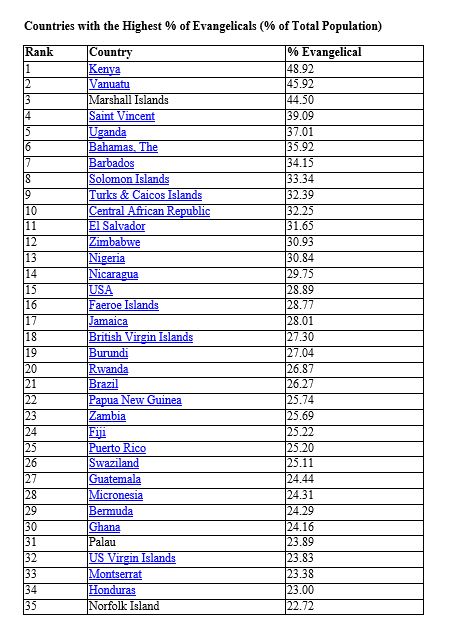
A couple notes about this chart. The USA is ranked pretty high, but there are countries ranked higher. These are countries in Africa, Latin America, Oceania and the Caribbean where the evangelical churches have grown tremendously in recent decades. Praise God! But this also means they are new believers with issues to work through, lack of established institutions, and other needs. This should be expected. What’s our excuse? Second, look through this list, and see if you find any other countries you could consider “prosperous.” The only possible one is Brazil, where there are prosperous areas and groups within a very large country, along with severe poverty and needs much greater than those in the United States. Most of these countries are small and politically insignificant (most of us couldn’t find them on a map) and dealing with a great deal of poverty and systemic internal challenges. Has your church sent mission trips to any of these places? I thought so. They have needs. Again, what’s our excuse? I understand that the media has made out American society to be coming apart at the seams, but it’s not because we don’t have good Christian teaching available to us, freedom and prosperity, but because we’re more interested in our lawns, in Keeping Up with the Kardashians and getting into futile political arguments than we are in following Jesus.
Please understand that I am approaching these difficult subjects for my own growth as well as that of others. If any self-righteousness comes through, I hope I can see it, acknowledge it and change. That’s one of the dangers in calling oneself and others to more faithful living.
Let’s put Jesus in the center, where He belongs. Not because we feel sorry for Him, because He needs nothing from us, but because it is better for us and the world. He longs for us to follow Him more closely, not because He needs it but because we do and He loves to meet our greatest needs.
Please leave your comments.
The Journey Begins
Thanks for joining me!
“Everyone then who hears these words of mine and does them will be like a wise man who built his house on the rock. And the rain fell, and the floods came, and the winds blew and beat on that house, but it did not fall, because it had been founded on the rock.” -Jesus, Matthew 7:24-25.

 HIS WORDS, HIS WORKS, HIS WAYS